
Nashville Bet Its New Downtown on Oracle. Oracle Sent Renderings.

The city capped its exposure. The exposure didn't disappear.
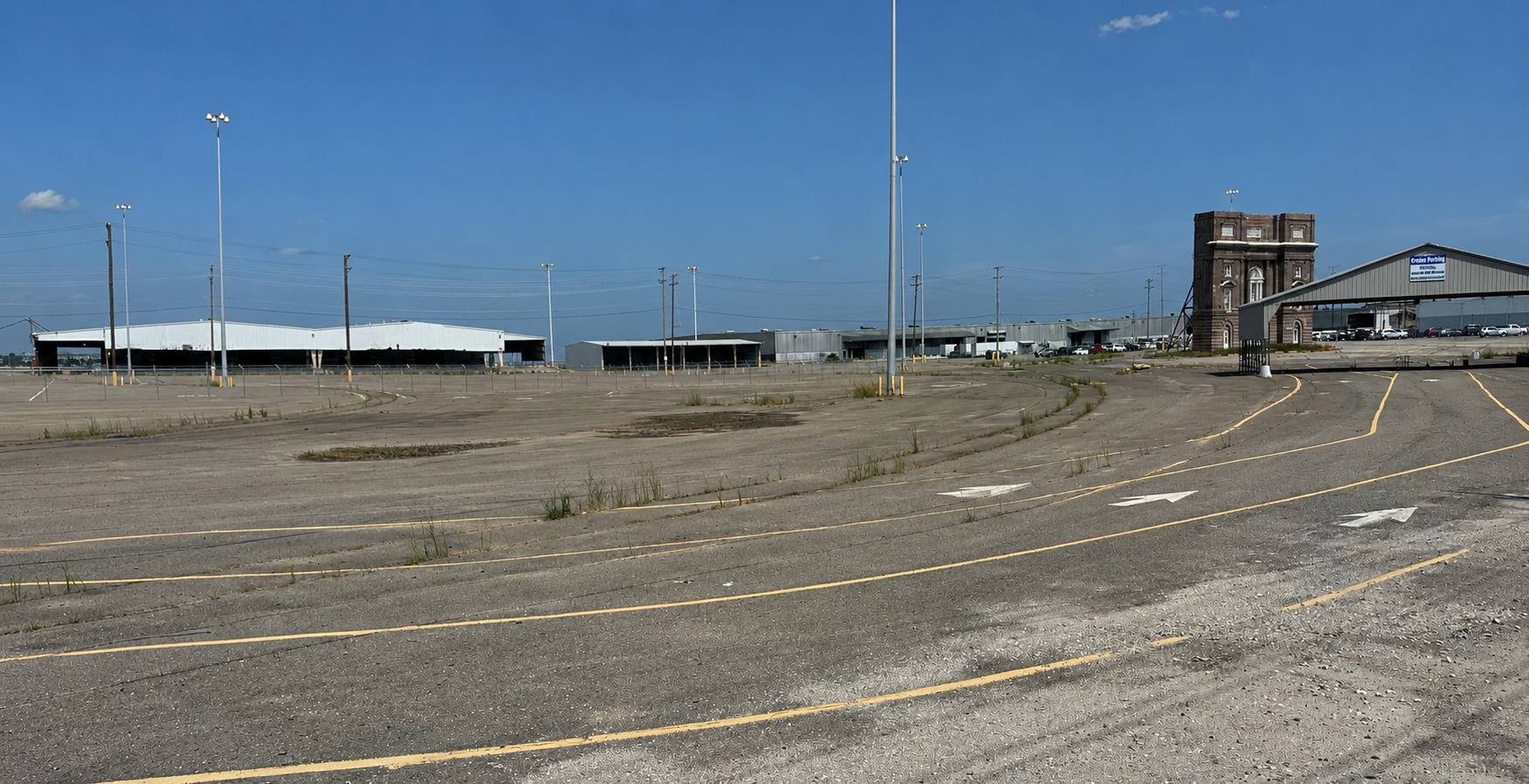
Oracle is supposed to be building its global headquarters on the east bank of the Cumberland River, across from downtown Nashville. Today, the site is parking lots, open riverbank, and the footprints of industrial buildings that have come down or are coming down. Oracle has pulled demolition permits for more than half a million square feet of those buildings, a grading permit, and an application for one of the two federal approvals a project this close to the water requires.[1] The site is moving, mostly through paperwork.
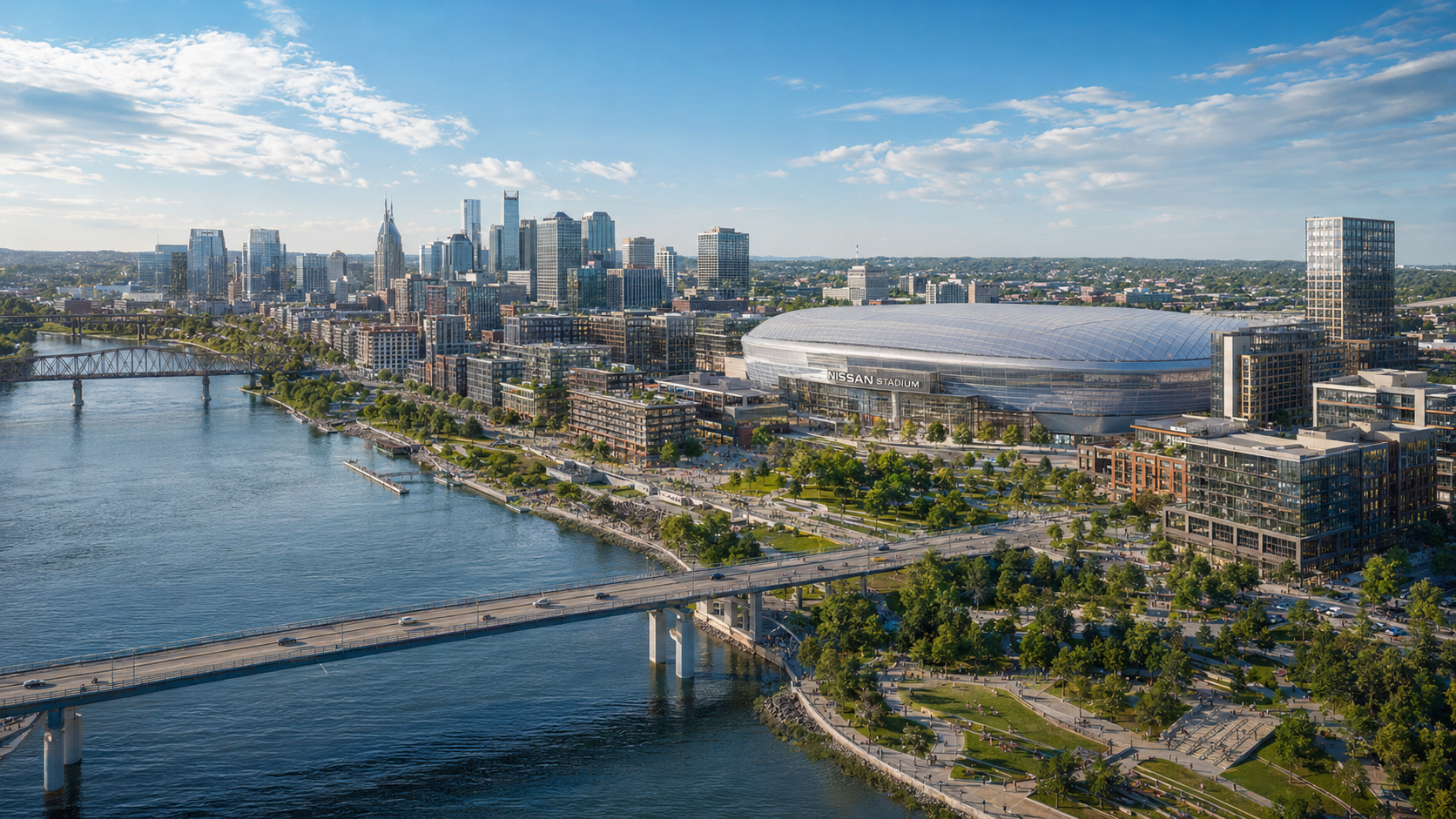
The renderings are further along than the ground. They show a campus set into trees, walking paths along the river, a Nobu hotel, and a pedestrian bridge arcing over the river. They have been shown to the Metro Council, printed in the news, and folded into nearly every public account of what the East Bank will become.
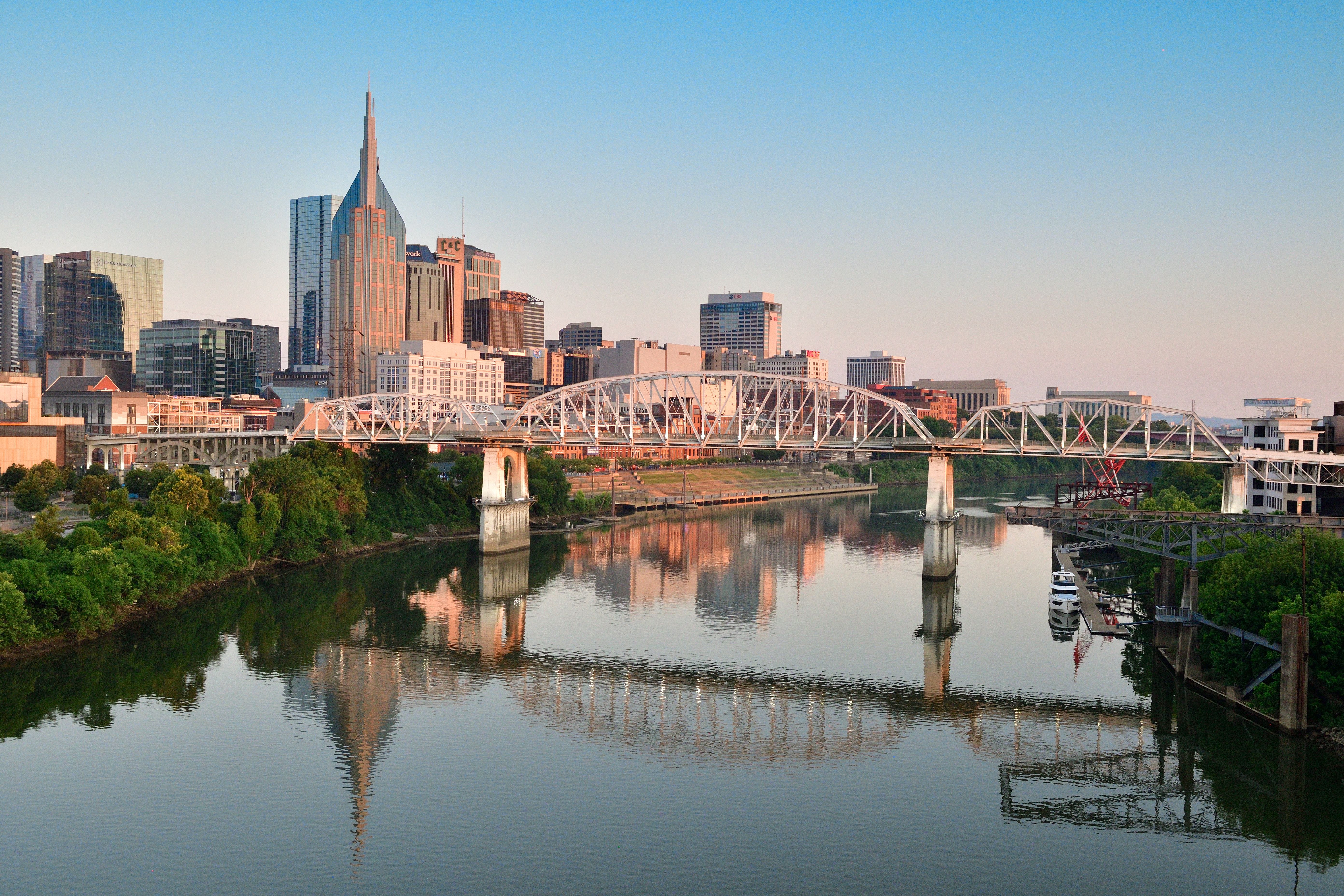
Across the river, in leased offices, Oracle now has room for about 2,000 people. The newest of those leases, signed in March in Germantown, sits directly across from the headquarters site. Oracle says the space will overlook the construction of its new campus.[2] For now, there is not much to overlook.
The number that made the deal was 8,500. In 2021, when the Metro Council approved the incentives, capped at $175 million, Oracle promised to bring 8,500 jobs to Nashville at an average salary of $110,000 by the end of 2031.[3] The figure is in the mayor's announcement, the council record, and nearly every story written since. It was the reason the city agreed to any of it.
Then the project grew. What was first described as a $1.2 billion investment is now a $4.5 billion one, on a larger footprint than the original plan drew. In 2024 Oracle went further and said Nashville would become its global headquarters.[4] That is ambition. It also raises a quieter question, the kind that surfaces when a project nearly quadruples in scale: did Nashville sign up for a headquarters arriving on a schedule, or for a private district whose pace Oracle alone would control?
The stakes were never only Oracle's, either. The idea of a new downtown across the river is the city's own, not Oracle's invention. Nashville spent two years on a plan it adopted in 2022, Imagine East Bank, covering 550 acres of parking lots and old industrial land directly opposite downtown, an area roughly ten times the Gulch.[5] That plan has pillars that owe Oracle nothing: a new $2.1 billion stadium for the Titans, a performing arts center moving to the riverfront, thousands of housing units on city land.

Oracle's piece was supposed to be different from any of those. A stadium brings event traffic. A concert hall brings cultural traffic. Housing brings residents. Oracle was meant to bring a daily working population of several thousand high-paid people, and the lunches, dry cleaners, office leases, hotel nights, and transit riders that follow them.
Five years in, Oracle has reported 901.
That 901 is the figure Oracle filed with the state's economic development office, against a promise of 8,500 jobs by the end of 2031.[6] Oracle has until that date, so the number breaks no promise. But it sets a pace, and at that pace 8,500 is a long way off. Reaching it would mean adding Nashville jobs far faster than Oracle has managed in the five years since the deal was signed.
The 901 is also the last count the public can see. Oracle filed a fresher one with the state in February, but the department has not released it, saying it is still checking the data.[6] Then, at the end of March, came the layoffs, which Oracle has not broken out by city. The only figure anyone outside the company can point to was filed before the most recent events that bear on it, and the company's own newer count sits unreleased in a state file.
The deal throws off more than one jobs number, tallied differently under the city and state agreements, and the coverage tends to conflate them. The conflation hardly matters here. None of the numbers is within thousands of 8,500.
A promise that specific, measured against numbers that scarce, breeds suspicion. By this spring, the suspicion had a name attached to it. Aftyn Behn, a state representative from Nashville, said her most generous reading of the arrangement was that Oracle is scamming Tennessee and Nashville, using public money to prop up a defunct business model.[6] Her least generous reading she did not specify.

Oracle's account is the opposite. The company says it remains committed to Nashville, points to the land it has bought and the buildings it has cleared, notes that it is expanding its leased offices rather than retreating, and describes itself as making real progress toward the campus it has always said it would build. It is still pulling permits. It is still signing leases. By its own telling, the headquarters is coming.
Both of these can be true at once, and that is the problem. A company can be sincerely committed to a project and still hold every lever that decides when, or whether, it arrives. So the useful question is not which press release to believe. It is narrower and harder: what has Oracle actually delivered, what did Nashville hand over to get it, and who absorbs the cost if the timetable keeps sliding.
Go back to the March lease, the one with the view of the site. A hundred sixteen thousand square feet in the Neuhoff District, and with it an announcement of what the space meant: offices spanning three Nashville locations, room for about 2,000 people, capacity for the company's growth.[2] Hold that figure next to the other one. Oracle has leased room for roughly 2,000 people and reported jobs for 901. The number it advertises is the capacity. The number it files with the state, and now withholds, is the occupancy. One is a forecast. The other is a count, and the count is less than half the forecast.
The bodies are not arriving fast enough to close the gap. Across all of last year, by one tally, Oracle's Nashville headcount grew by a net seven.[7] The leases keep getting larger while the workforce barely moves, which is an unusual way to run short of space.
This is what Oracle's evidence of commitment looks like once it is sorted. The land, the permits, the demolitions, the leases: every item is something the company has bought or rented, not someone it has hired. A headquarters is finally counted in people. Oracle has been generous with the other numbers and quiet about that one, and it has just sealed that one entirely.
It helps to know what Nashville actually agreed to, because the city was careful, and the care is the point. Metro did not write Oracle a check. The structure is a reimbursement. Oracle pays up front for infrastructure and site work, the pedestrian bridge, the sewers, a riverfront park, the cleanup of an old landfill, and the city pays it back over time, capped at $175 million, out of half the new property tax the development itself generates.[8] No new debt. Nothing from the operating budget. If the tax revenue never arrives, the reimbursement never comes due. By every test a finance officer would apply, this is a disciplined deal, and Metro deserves the credit for writing it that way.
Now read it again for what it protects. Every safeguard guards the same thing: the city's cash. The cap protects the cash. The pay-as-revenue-arrives mechanism protects the cash. The no-debt structure protects the cash. What none of it touches is the city's time. Nashville protected itself against a direct cash loss but not against a lost decade.
That is the asymmetry. A capped exposure is not a hedged one. The city limited the dollars it could lose and left unguarded the thing it was actually spending: years of planning, sequencing, public attention, and adjacent expectation, all organized around a headquarters arriving on a schedule only Oracle controls. Across the city and state agreements both, whether anything binds Oracle to interim job numbers, backed by a real penalty for missing them, the public record does not yet show. What it shows is a city that bound itself to a date and a company that did not.
None of this requires Oracle to be acting in bad faith. There are real reasons a headquarters like this one moves slowly, and they are worth laying out, because the honest version of the story does not need a villain.
The first is the site. You do not raise a campus on a riverbank the way you fill an existing tower. The land had to be assembled and cleared, the ground graded, a bridge designed, streets and sewers planned, zoning changed, and federal permits sought for building this close to the water. Oracle has been doing those things. They take years, and they would take years even for a company in a hurry.
The second is that the people are not moving. Oracle inherited thousands of employees in Kansas City when it bought the health-records company Cerner, and most of them are still there. It has reportedly offered workers money to relocate to Nashville and met resistance, including worry about landing in a lower pay band.[7] A headquarters that depends on moving thousands of high-paid workers has to actually move them, and so far the workers have had opinions about that.
The third is that Oracle is no longer the company that signed the deal. The spring layoffs were part of a broader contraction: over its last fiscal year it cut its workforce by roughly 21,000 people, about 13 percent, and tied the cuts in part to artificial intelligence, the same technology it is pouring capital into across its data centers.[9] Oracle says AI now lets one engineer finish in weeks what once took a small team months.[6]
That last point is where the easy story and the true one part. The easy story says AI killed the Nashville deal. The truer one is narrower: AI weakened the single assumption the whole arrangement rested on, that a growing Oracle would need thousands more people at desks in one place. Oracle can grow now and shed headquarters jobs in the same breath, and it is doing both.
So who is getting played here? It is the question underneath all the others, and the honest answer is less satisfying, and more troubling, than the question wants.
Start with Oracle, because Oracle has the most latitude. It owns more than seventy acres on a riverfront its own arrival helped make more valuable, it holds the levers that set the pace, and it can answer any critic with a true sentence about permits filed and leases signed.[10] It carries real costs of its own, the money tied up in land, the expense of building later in a more expensive decade. But it has not been forced into anything, and it has not taken a loss. Time, for Oracle, is something it owns.
The city is in a different position, though its loss does not show up as a number. Metro bent a decade of planning, sequencing, and public attention around an anchor that has not arrived, and that cost is the hardest kind to put on a ledger: the other things the city might have built its riverfront around, the years it cannot get back, the momentum it spent on renderings.
Then there are the people who believed the renderings with their own money. Developers and landowners who bought in around the site, betting that several thousand Oracle workers were coming soon, are carrying the risk the city was careful not to carry. Their mistake, if it turns out to be one, was not the place but the timing, and the timing is the one thing Oracle kept for itself.
So far, no one has been played. Nobody has taken a realized loss, Oracle least of all. The trouble is the shape of the thing: the city capped its exposure, and the exposure it shed did not disappear. It moved downstream, onto people with less protection and less information, who are now holding a timetable they do not control and cannot see.
It would be easy, from all this, to conclude that the East Bank is in trouble, and that conclusion would be wrong. The district does not depend on Oracle the way the headlines suggest. It has a new stadium going up, a performing arts center planning to move, thousands of apartments rising on city land, and a vision the city adopted before Oracle's role was ever settled. Where it has slipped, Oracle is usually not the reason. The performing arts center's move is in doubt over who pays for infrastructure, and the first private buildings have slid toward a groundbreaking at the end of this year, both for reasons that have nothing to do with a software company across the site.[11]
So the real risk is character, not collapse. The East Bank can still become a thriving district. The question is what kind. The stadium, the concert hall, the apartments: each fills the district in bursts, on game nights and show nights and the ordinary comings and goings of people who live there. Oracle was meant to bring the other rhythm, the weekday population that fills a place at noon on an ordinary Tuesday, the several thousand people whose midday errands and after-work drinks turn a development into a neighborhood. That is the part still sitting in renderings. The East Bank can succeed without it, the way an event district succeeds. It just will not be the downtown it was promised to become.
Oracle may yet build all of it. The campus could rise, the bridge could span the river, the workers could come, and in 2032 this could read like an essay that mistook a slow start for a broken promise. That outcome is still available to everyone.
But the deal has already changed shape. Nashville set out to recruit a headquarters and ended up wagering a new downtown on a timetable, then leaving that timetable in Oracle's hands. Oracle holds the land and sets the pace and answers with renderings and leases. The city, its planners, and everyone who bought in nearby hold the wait.
It is worth standing for a moment at the new windows in Germantown, the ones Oracle leased this spring, the ones it said would look out on the construction of its headquarters. Across the river is the site. There are permits on it, and grading, and a fence, and a set of beautiful drawings of what is supposed to rise there. Five years in, the one thing missing is the building. The anchor is still a rendering.
Notes
[1] The Real Deal, "Oracle Moves to Clear Nashville Land for $4B+ Campus," January 16, 2026: demolition permits (~515,000 sq ft), grading, federal permitting, and the $4.5 billion campus figure.
[2] Oracle, "Oracle Scales Up Nashville Offices to Support Rapid Growth" (press release), March 26, 2026: the 116,000-square-foot Neuhoff District lease, roughly 2,000 seats of office capacity across three Nashville locations, and the statement that the new space will overlook construction of the headquarters.
[3] Metropolitan Government of Nashville (Mayor's office), 2021 announcement of the Oracle agreement: 8,500 jobs at an average salary of $110,000 by the end of 2031, and up to $175 million in infrastructure incentives.
[4] Metropolitan Government of Nashville, bond official statements (2024–2026): the expanded project scope (approximately $4.5 billion and nearly 80 acres) and Oracle's 2024 designation of Nashville as its global headquarters.
[5] Metro Nashville, East Bank Development and the "Imagine East Bank" vision plan (adopted 2022); Tennessee Lookout, October 7, 2025: the 550-acre redevelopment area, the new Titans stadium, the performing arts center relocation, and Fallon's initial development area.
[6] Axios Nashville, "Following layoffs, Oracle pursues zoning change for East Bank campus," April 13, 2026: 901 Nashville jobs reported to the state before the spring layoffs; a later February filing withheld pending state verification; Rep. Aftyn Behn's characterization of the arrangement; Oracle's claim about AI productivity; and the federal permit application.
[7] Fortune, "Oracle struggles to attract workers to Nashville 'world HQ,'" January 15, 2026 (reporting from Bloomberg): net Nashville headcount growth of about seven in 2025, thousands of employees remaining in Kansas City following the Cerner acquisition, and relocation incentives and pay-band concerns.
[8] Metro Nashville Economic Impact Plan, River North; and Axios Nashville, April 13, 2026: reimbursement of up to $175 million in qualifying infrastructure costs, funded from 50% of the development's future property-tax increment.
[9] Reuters, "Oracle workforce shrinks by about 21,000 employees amid AI adoption," June 22, 2026: the fiscal-2026 workforce reduction of roughly 21,000 (about 13 percent), tied in part to AI.
[10] East Bank Development Authority: Oracle's acquisition of more than 76 acres and roughly $379 million invested in land.
[11] NewsChannel5, March 5, 2025; WKRN, December 31, 2025: the performing arts center relocation in doubt over infrastructure-cost disputes, and the delay of Fallon's first buildings toward a late-2026 groundbreaking.