
Meta Built $41 Billion in Data Centers with No Money Down and a 48-Month Lease.

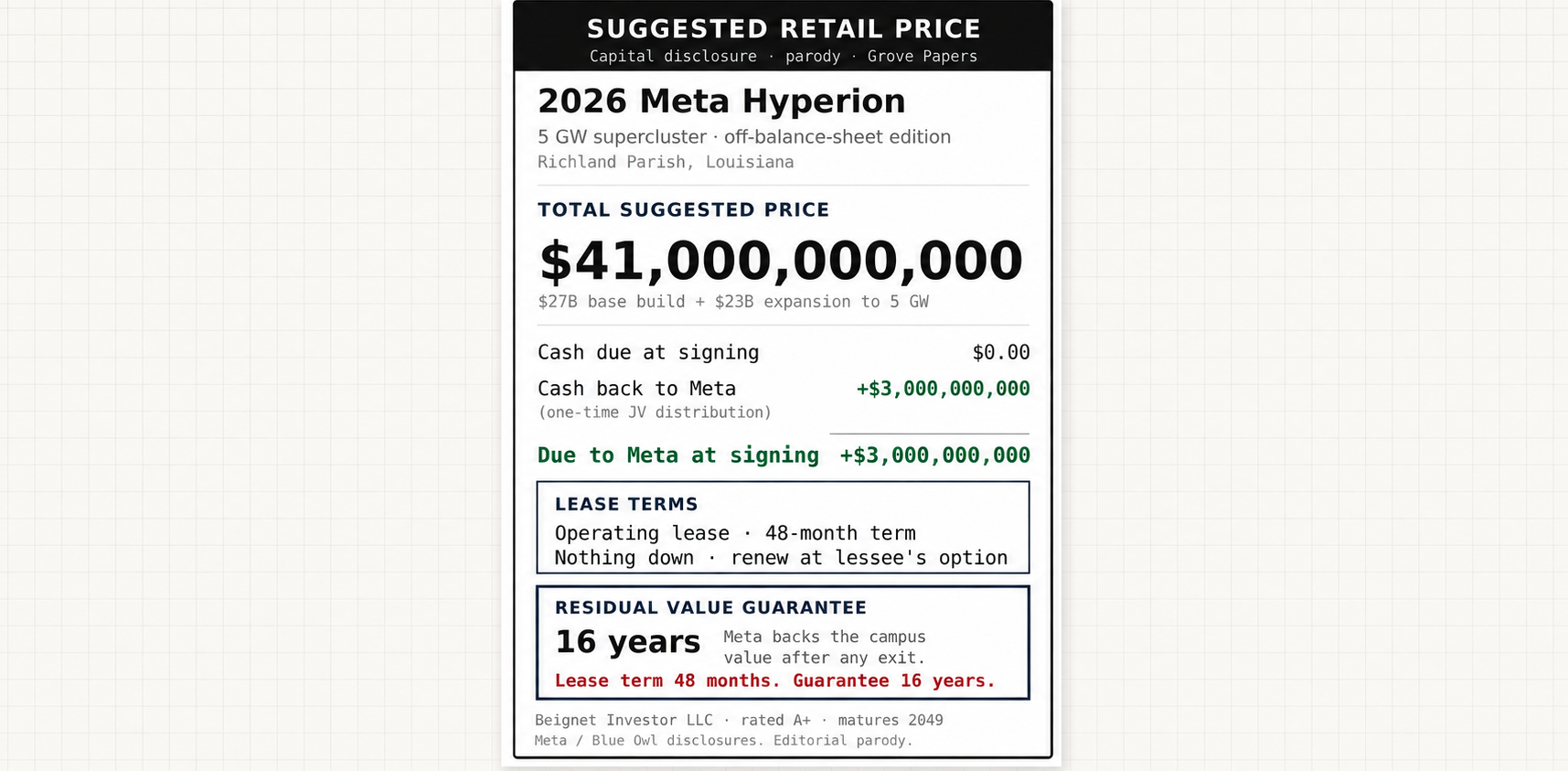
The accounting structure that helped bring down Enron is back.
In the late 1990s, Enron used special-purpose entities to keep billions in debt off its balance sheet. They kept it secret, and it was fraud. The companies bankrolling the AI boom are doing the same thing now. The difference is they disclose it.
In Louisiana, Meta is building a five-gigawatt campus, more than $50 billion, that could become the largest data center on Earth. It is building a smaller one in Texas, which I would still describe as huge.
It has financed both so the debt stays off its own balance sheet, which pushes the risk downstream, to pension funds, insurers, and ordinary retirement accounts.
On July 28, Meta and BlackRock announced a $14 billion data center in El Paso. BlackRock’s funds will own 80 percent, Meta 20. A new company, Sopaipilla Investor LLC, will borrow $12.5 billion to build it. Meta will lease the finished campus back from the venture, four years at a time.
Nine months earlier, it ran the same play in Louisiana. Blue Owl’s funds own 80 percent, Meta 20. Beignet Investor LLC borrowed $27.3 billion against the project. Meta leases that one back too, four years at a time.
A beignet is fried dough. So is a sopaipilla. The naming department may know more than the lenders do.
Together the two ventures come to about $41 billion. Every lender in both bought the same thing: Meta’s promise to pay rent. Each deal prices that risk on its own. What none of them prices is that all these campuses ride the same demand curve.
The risk is sold as many separate bets. It is one bet, placed over and over.
Meta is not short of cash. It spent more than $60 billion on capital projects in 2025 and could have written a check for either campus. It didn’t, and it plainly could have, because it carries the larger Louisiana expansion, the part beyond the venture, on its own books. So one campus is financed two ways: the venture’s $27 billion off Meta’s books, the rest on them. Which debt goes off the books and which stays on is Meta’s choice, not the market’s.
The structure buys Meta three things. It keeps control and exclusive use of a building it mostly does not own. It puts in less cash at closing and takes cash out, roughly $2.6 billion in Louisiana and $1 billion in El Paso, for agreeing to the split. And the construction debt is never consolidated as its own.
Two things keep it off the books: the lease and who counts as the owner. On paper, Meta owns a fifth of the venture and does not control the re-leasing or resale of the campus, so the accountants do not call the debt Meta’s. The lease does the rest. It runs four years at a time, not the twenty it should reach, so only the near term lands on the books. The guarantee stays off until Meta is likely to pay it, which is to say not yet. None of this denies the obligations. It just records each one when it crosses a different line, and the lines are far apart.
The debt left Meta’s balance sheet. Much of the economic dependence did not. Its own filing puts the maximum exposure at about $46 billion. In both deals, Meta also signed a residual value guarantee. In El Paso, it starts around $13 billion and declines over time. If certain conditions are met within the first sixteen years, Meta owes the venture the shortfall below the guaranteed figure.
The El Paso bonds mature in 2048. The Louisiana bonds mature in May 2049. The lease runs four years. The guarantee runs sixteen. The debt runs more than twenty.
The risk did not disappear. Meta cut it into pieces, gave each a date, and placed them on different balance sheets.
Until the leases begin in 2029, no rent comes in at all. The bond lives on the cash raised up front, the interest that cash earns, and Meta’s promises during construction. Then the rent starts, and it covers the debt by a hair, about a dollar ten for every dollar owed. The guarantee is no help in a bad year. It pays out only if Meta walks away and the campus is by then worth less than a figure that shrinks every year.
Here is what the bondholders do not have. They do not hold a mortgage on the campus. If the deal fails, they cannot foreclose on the land and buildings, because the bonds were issued a floor above all that, by the holding company that owns the fund’s side of the venture. Their collateral is that ownership stake, not the concrete. They are lending against Meta’s word and sitting one door away from the thing the word is about. The rating agencies have noted that the money comes from Meta’s lease, not the building. It is why the bond prices a notch under Meta’s own debt. It is Meta’s credit, minus the collateral.
Who holds each layer is partly on the record. The equity came through Blue Owl, whose clients include pensions, insurers, sovereign funds and endowments. The debt is easier to trace. PIMCO took about $18 billion of it. BlackRock took more than $3 billion. And in May, New Jersey’s Police and Firemen’s Retirement System bought $6.4 million of the Beignet notes straight from Goldman Sachs.
A police officer’s pension and a field in Richland Parish now share a maturity date.
The market has begun to charge for it. Louisiana’s bond went out easily last October. El Paso’s, this month, went out harder, near three points over Treasuries and a yield close to 7.5 percent, after a selloff in big-tech debt. Same tenant, same template, higher price. The second was a tougher sell than the first.
Meta is not the only one doing this. Oracle built data centers the same way and leased them back, and in January its bondholders sued over losses tied to the buildout. Four senators have asked regulators whether all this debt, kept off the tech companies’ books, could put the financial system at risk. The Bank for International Settlements has a name for it: shadow borrowing. It makes the point that moving debt off the balance sheet does not make it any smaller. What Meta ran twice is turning into how the whole industry pays for itself.
Not all of that industry is built like Meta’s, and the difference is worth holding onto. The reckless money is elsewhere, in the smaller cloud firms borrowing against the chips themselves to rent computing to AI startups that do not yet turn a profit. That is the paper that looks like subprime, and it may well be. Meta’s bonds are the respectable end of the same street. Investment grade, backed by a tenant that can pay. And that is the trap. The danger is not a weak borrower. It is a strong one, strong enough that everyone leans on the credit and stops asking whether the demand under it ever shows up.
The same risk is working its way toward ordinary people, more subtly than through pensions and insurers. Private-credit funds have been opening their doors to retail savers, and a 2025 federal order told regulators to make this kind of asset easier to hold in a 401(k). Moody’s, for its part, has warned that current accounting can leave hundreds of billions in leases and guarantees off the reported books, and says it will start marking its ratings to what it thinks is really owed.
The financing is one story. The power is another, and it does not run through the venture at all. To feed the Louisiana campus, Entergy has three gas plants approved and seven more waiting on a ruling due in December. Ten plants for one data center, about 7.5 gigawatts and $11 billion in generation. Entergy says its deal makes Meta pay the full cost of serving the campus for fifteen years.
The deal with the power company is narrower than it sounds. Entergy wants to buy an old Texas plant called Cottonwood, and by calling it a system need rather than a Meta need, it places the cost outside Meta’s guarantee. A consultant to the state regulators tied the purchase straight to the gap Meta’s campus opens up, and priced it at $8 to $13 a month on the average household bill.
Then there is a $550 million transmission line Entergy admits it would not build but for Meta. And the plants themselves last about thirty years, while Meta’s promise to pay for them runs fifteen. If Meta walks at year fifteen, someone carries the back half, and regulators will have to decide who. Critics say it lands on ratepayers. Entergy says its agreements protect them and will save other customers about $2 billion over twenty years. One commissioner voted no and called it a generational risk. The agreements that would settle the argument are sealed.
The power bill is one way this reaches a household. Every month, the campus’s power costs show up in what ratepayers across the region owe. The other way only bites if things go wrong: the same household’s pension or 401(k) may hold the bonds, and takes the loss if the deal fails. One is a charge you pay now. The other is a risk you carry without knowing it. The last piece traced the power bill. This is the part it leaves off.
The question was never whether Meta pays its rent. Meta pays its rent. The question is what a specialized, power-hungry, single-tenant campus is worth once the guarantee has run down and the lease comes up to renew. The buildings may stand for decades. The chips inside them, the cooling they need, the kind of computing they were built for, will not. It is a long bond against a short-lived machine, and nowhere do the documents say what the machine is worth in year seventeen.
There is a bigger version of that question. The market charges more for each new deal, but no single bond prices the one thing they all share. Each is written against one company’s credit, on its own, as if the campuses had nothing to do with each other. They have everything to do with each other. They are the same bet, that AI demand keeps climbing. If it does, everyone gets paid. If it does not, the loss comes out in different places at different times: Meta’s rent and guarantees, the funds’ equity, the bondholders’ notes, and, on a wholly separate contract, the power plants built to feed the campus. The last piece asked who takes the loss if the demand never arrives. Here is the answer. Not the public alone, and not nobody. Pensions, insurers, savers and ratepayers, each holding a piece with a date on it.
Whether this is another 2008 is the question everyone asks, and it is the wrong question. This is not subprime. The tenants can pay, and the buildings are real. It is closer to 1999’s overbuild running through 2008’s plumbing, the demand risk of the dot-com era on the credit machinery that came after it. What both crises had in common was the habit of pricing one shared risk as a hundred private ones.
That habit is back.
The lesson keeps arriving in the same shape. A four-year lease. A sixteen-year guarantee. A bond to 2049. A gas plant with thirty years of life and fifteen years of cover. Meta divided the risk with care, one deal at a time, and the contracts name who takes each loss and the year they take it.
What no single contract shows is that all of them are the same bet.