
My Great-Grandfather Bought Coca-Cola in 1910. The Six Billion Dollars Never Existed.

If my great-grandfather had put a thousand dollars into Coca-Cola stock in 1910, held it without ever touching it or distributing a cent, and his heirs had done the same across every generation since, the position would be worth roughly six billion dollars today.
He did buy it. The position is, unfortunately for me, worth considerably less than six billion dollars.
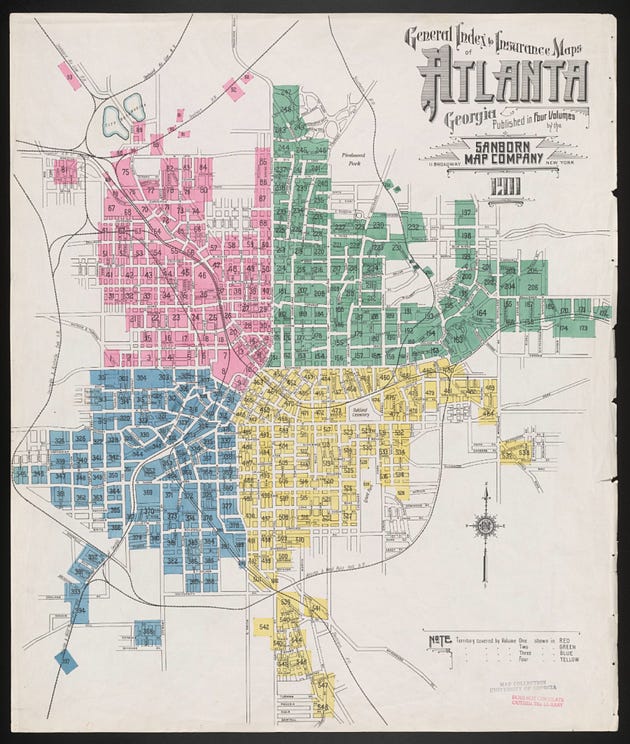
I found him in the 1910 census: Thomas, age thirty, living at 545 Spring Street in Atlanta, occupation listed as insurance. His son's age was recorded as "1 3/8ths," the notation census enumerators used for young children that year. The Sanborn fire insurance map from 1911 shows his block in enough detail to see the lot's footprint, the width of the porch, the distance to the nearest streetcar line. Old business directories place his employer, Union Central Life, on the fifth floor of the Candler Building on Peachtree Street.
The records are documented. The morning I am about to describe is reconstructed from them, and I have tried to be honest about the seams.
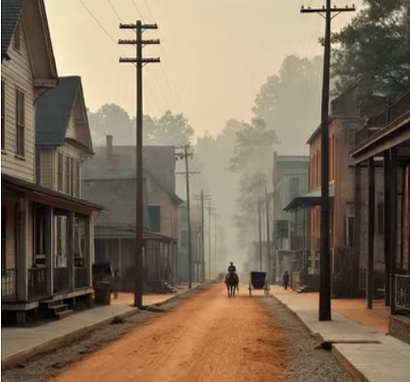
Thomas stepped off the wooden porch of 545 Spring Street earlier than usual that morning, the boards creaking in a cold that had no business being there in April. The air still held the bite of the previous night's frost, the thin remnant of a rare spring snowfall. The house behind him smelled of coal smoke and biscuits. His son had reached for him as he dressed and left a few crumbs on his cuff. He brushed them off and smiled in spite of himself.
The letter was in his inner pocket, next to the small leather notebook he carried everywhere. It was short. Too short.
Kindly come before noon. There is a matter in which your discretion and judgment may be of service.
It was signed A.W. Calhoun. Calhoun moved quietly through Atlanta's legal, insurance, and finance circles. He was not a public man, but he was close to the Candlers, close to the rail men, and known to advise on the private deals that passed between bankers, church elders, and Coca-Cola insiders. Thomas's father had served with him on church committees in the 1880s. They had exchanged letters once over a property matter. Enough to be recognized. Not enough, yet, to be trusted.
That was how a deal arrived in 1910. Not through an advertisement or a prospectus, but through a letter from a man you had met through your father, written on the stationery of someone connected to the circles that mattered, asking for your discretion. The channel and the opportunity were one thing. To receive such a letter was to be told something not just about the investment but about your own standing and what it might become. Men who misread what these circles asked of them rarely got another chance.
He walked south through the quiet stretch of Spring Street until the houses broke at Simpson. A milk wagon went past, the driver hunched low against the cold. From the west came the first sounds of the rail yards, the low grind of cars shifting and the thin whistle of an engine warming.
The city around him was barely seventy-five years old and already held 154,839 people, sixty-five thousand more than a decade earlier. Streetcars clanged over eighty miles of track and moved forty-five million riders a year. Electricity had reached perhaps a third of the homes near downtown, and a lit window after dark still drew people onto the sidewalk to look. Barely a fourth of households had indoor plumbing. There was no income tax, no Federal Reserve, no insured deposits, no amortized mortgage. Life expectancy hovered around fifty.
A man like Thomas, if he wanted to do something with his savings, had a short list. A bank account paying 3 to 4 percent, at a bank he trusted well enough, in a country where banks failed regularly and deposits were not insured. A small rental lot. Railroad bonds at 4 to 6 percent. A stake in a local business where he knew the owners personally. There were no index funds, no brokerage accounts for ordinary people, no financial press covering markets for general readers. Stocks were technically available and practically reserved for men with capital and connections. To invest in a company was to invest in someone you knew, or someone vouched for by someone you knew. Everyone also knew a man whose shares had become worthless overnight, because that happened too.
Rumor in the Candler Building held that Coca-Cola, still a private and tightly held family enterprise, was preparing to reorganize some of its early shares. Nothing public or official. But fragments had been drifting through the insurance offices for months: new bottling contracts, quiet expansion into small towns, a push to buy out earlier noteholders. If Calhoun's letter had anything to do with that, and Thomas was already wondering if it did, it could change the footing of his life. It could also cost him everything he had managed to save.
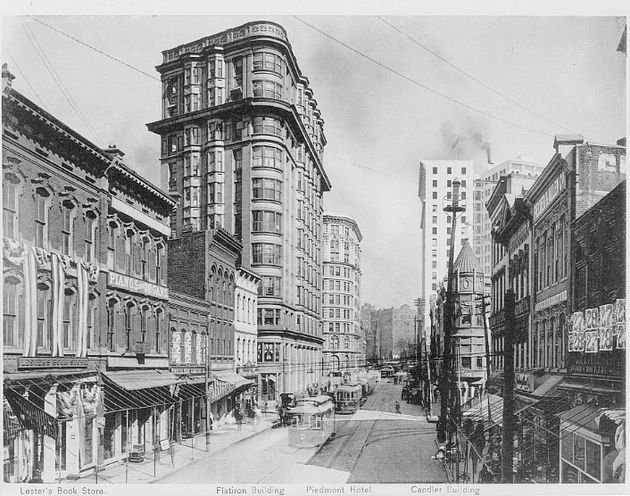
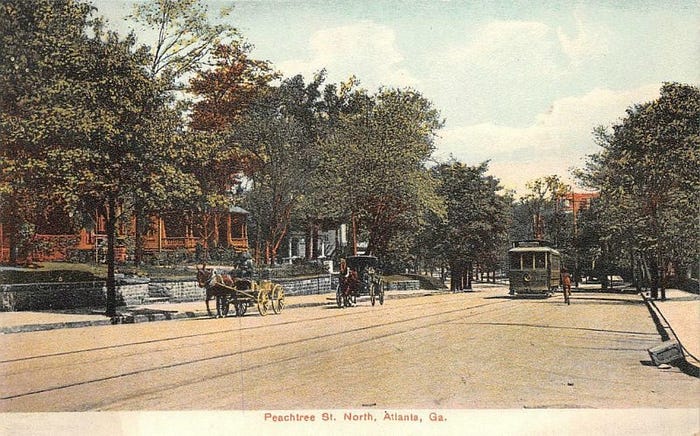
Peachtree met him with a quicker rhythm. Shopkeepers lifted their shutters. Clerks moved in stiff collars and cold breath. A streetcar clanged past, sparks jumping from the trolley wheel, and a delivery wagon pulled aside to let it pass. Newsboys stood where the sidewalk brightened, shouting news of Halley's Comet.
No one on that sidewalk could imagine the century that was coming. They had no frame for global wars fought with industrial weapons, or for federal spending rising from a distant abstraction to the organizing force of everyday economic life. Insured deposits, a central bank steering interest rates, a government tracking wages and income: not on the list. Automobiles reshaping the cities, antibiotics, mass media, computers connecting the world through invisible networks. These were not even wrong predictions. They were outside the available imagination.
Into that world, Coca-Cola was beginning to look like something. The red script was appearing on storefronts across the South. Bottling contracts were spreading into small towns. The Candler Building itself was evidence: Asa Candler had built it partly to show Atlanta what a soft drink company could become. Seventeen stories of Georgia marble and steel, barely four years old, its white face lifting above the roofs to take the first hard light of the day. But it was still a private company run by a man with a gift for promotion, and its future was not legible from a fifth-floor office on Peachtree Street.
Thomas paused at the entrance as he often did. Then he opened the brass-handled door and stepped inside.
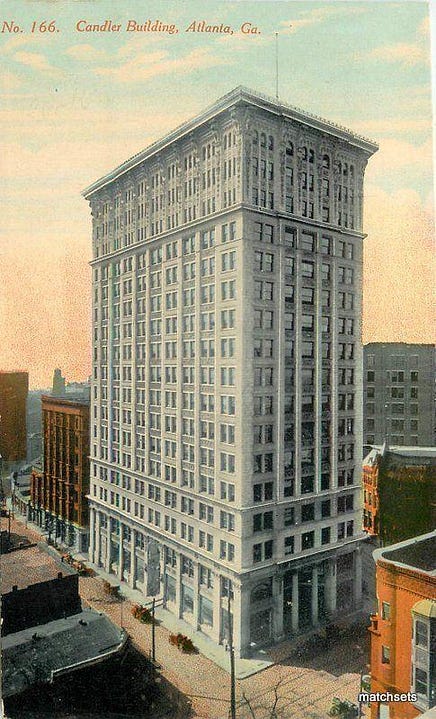
The lobby murmured with typewriters and telephones. Coca-Cola men moved down the corridors carrying ledgers stamped with the red script. Thomas took the elevator to the fifth floor, set his notebook on his blotter, and looked out the window. Whatever waited would not improve by delay.
Calhoun's door was closed. Thomas knocked.
After a long moment, a thin, steady voice came through the door. "Come in."
Calhoun sat behind a modest wooden desk, correspondence arranged in orderly piles. He had grown thinner since Thomas had last seen him, the lines around his eyes deeper. A silver-tipped cane leaned against the wall within reach.
"Mr. Daniel," Calhoun said, with a faint gesture toward the chair opposite. "You got my note."
"I did, sir."
"Good." Calhoun studied him for a moment. "We have matters to discuss and not much time to waste."
Thomas sat.
A thousand dollars was most of his savings. He had a family, a mortgage, a son who had not yet learned to walk. There was no one to call for a second opinion, no financials to look up because they were private and unavailable. There was only what he knew, what the channel implied, and what he understood about the direction of things.
He said yes.
The decision, like all decisions, moved through time and became other decisions. Thomas held the stock. He also took distributions over the years, because he was alive and his family needed things. When he died, what remained passed to the next generation, who made their own choices with what they received. A family is not a holding company. The money moved through the Depression, through two wars, through the whole long arc of the twentieth century, and was used along the way. That is what money is for.
The six-billion-dollar number, which assumes that nothing was ever distributed, nothing was ever needed, and no generation ever made a different choice, belongs to a family that never existed. What Thomas's decision actually produced is smaller and more human, and it remains a matter for the family, not this essay.
What he could see that morning was what was directly in front of him: a city changing at a pace that had outrun anyone's frameworks for judging it, a letter from a man connected to the circles that mattered, a risk that was real and could not be quantified, and a judgment call about whether the moment required yes or no. None of that has aged.
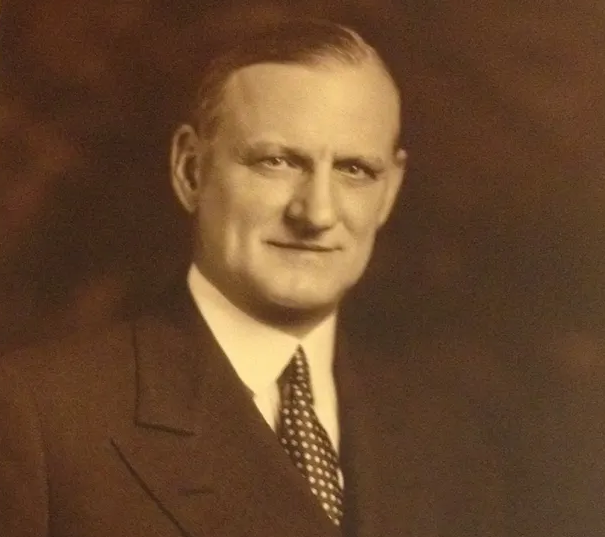
I have a photograph of Thomas, later in life. He is looking at the camera with the settled expression of a man who has made his decisions and is no longer much worried about them. I cannot ask him what Calhoun said, or what he thought about on the walk back down Spring Street, or whether he knew, eventually, what he had been holding all along.
What I have instead is the record: the census entry, the Sanborn map, the photographs of the Candler Building in its first year, the documents that place him on a specific block on a specific morning, standing at the edge of something he could not fully see.
He walked into a building in the spring of 1910 and said yes. That is all any of us ever do.
Daniel Sexton is Managing Partner of Vanguard Industrial Partners and founder of Arkvera. He works on the deals and developments where capital alone isn't enough.